Monday, April 25, 2011

The Disappeared, by Kim Echlin

The Disappeared is yet another story about the cruelty with which humans treat one another. Set during the rule of the Khmer Rouge, the story deals with a Cambodian who escaped during the initial genocide and the Canadian wild child who fell in love with him and risked everything to be with him.

Serey is the Cambodian boy who escaped without learning the fate of his birth family. While in Montreal, he meets and has an affair with a teenager, Anne Greves, herself a motherless child with an often-absent (physically and emotionally) father. They fall in love despite the objections of Anne's father and have an idyllic affair filled with poetry and music.

What Anne fails to grasp - because it's outside her realm of perception - is that Serey can never be complete as long as he is exiled from his country and does not know the fate of his family. She understands on an intellectual level, but doesn't grasp the situation's reality until the Cambodian border opens back up and Serey immediately makes plans to go home and find his family.

Their separation ends up lasting 10 years.

In the intervening 10 years, Anne learns the Khmer language and writes letters to Serey (which he never receives; Anne never receives the letters he has written her either). She takes lovers but never falls in love. And finally, after convincing herself that she sees him on television at a rally in Cambodia, she decides to go looking for Serey. Showing enormous courage and resourcefulness, she goes to his old neighborhood - nobody has seen him. She cruises nightclubs and music halls to try to find him. She asks in the market square. Finally, she finds him.

But all is not well - this is not a book with a happy ending. They live together, resume their love affair, and Anne eventually gets pregnant. Tragically, she loses her baby when she contracts dengue fever, and then she loses Serey - he disappears again. Before he disappears, Serey finally reveals to Anne that his brother had survived the genocide...after witnessing the murder of his grandmother, mother, and father. In a last act of bravery, his father threw Serey's 10-year-old brother into the ditch on the opposite side of the road to help him escape being killed. These events, and the hardships that came after, molded Serey's brother into the perfect foot soldier for the Khmer Rouge.

Anne finally learns that Serey had been working for the resistance movement. She is warned again and again to stop looking for him. But her obsessive love will not allow her to quit and she finally finds his skull - he was killed for his resistance activities.

This book is depressing as hell; if you've ever read any books about other "disappeared" people, you'll know what I mean. The bad guys usually prevail, there is always family tragedy and loss, and the people who survive genocide are permanently damaged in ways that those of us who have not (thankfully) live through these events can probably never fully understand. It warps people - those who escaped altogether and those who escaped murder only to be conscripted into the murderers' ranks. It stunts their lives - they live with the tragedy of their murdered families and the guilt that comes with surviving such an event. Love - if they are able to have it - is deeply felt but is always accompanied by an emotional distance. This novel captures this intensity and disconnection perfectly. The plot is at turns disjointed, secretive, passionate, and tragic. This book is a tragedy.

What are YOU all reading lately??

Friday, February 25, 2011

Great Gatsby for NES!!


It's true. These folks found a pirated edition of a rare Nintendo game adapted from the Great American Novel, F. Scott Fitzgerald's The Great Gatsby. As Nick Carraway, you throw fedoras at hobos and flappers in search of Jay Gatsby.

Just like in the book.

I read this in high school. Who taught that class? Mark Sager. I can attest that when Mark teaches this, he does every character with a distinct voice, even Daisy.

Play it here.

Monday, February 14, 2011

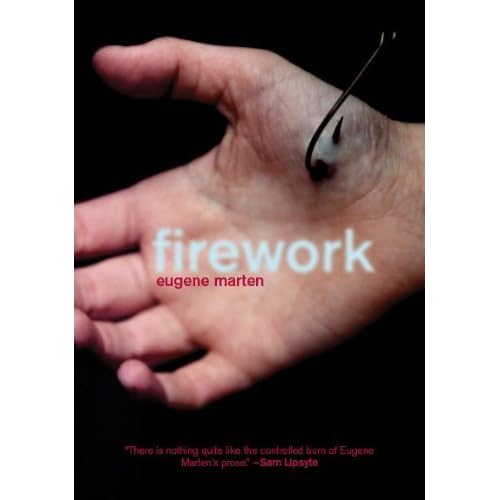
Firework, by Eugene Marten


Y'all are getting lapped.


I'm in Portland now. After two months of unseasonal warmth, the sky has decided to get gray and spit rain for this week. It definitely beats the Snowpocalypse in the northeast, though.


Well, to mark my glorious return, we're gonna look at a book that unwittingly took me back here a week before I actually arrived and shattered my expectation for a protagonist. Firework, by Eugene Marten.


First off, I want to say that one person this book is dedicated to is Gordon Lish. I don't know the connection between Marten and Lish (there's very little about Marten out there), but this book is reminiscent of the hard, existential daily-life realism that Raymond Carver worked in, as well as the supreme stylistic flourishes of that realism that can be found in Amy Hempel and Tom Spanbauer. Like Palahniuk (a student of Spanbauer), Marten loves to write in the language of physical process and parts, which contrasts his main character rather well, because, compared to all the knowledge and names surrounding him, he's just a regular guy writing a crappy screenplay and is dissatisfied about his life, but not imaginative enough to change anything. He only knows that he used to be brave.


Marten stretches and spins ordinary minutae to plumb the depths of an incapable, nearly-opaque, and not-entirely-likable character, Jelonnek, who reminded me of Denis Johnson's character, Fuckhead, from Jesus' Son, in that he is ignorant, afraid and utterly awash in a world of confusing relationships and interactions, in which he is some dangerous, reactive element.


This book is unique in that it's only calm spots are a disintegrating stasis. Jelonnek is a state worker who oversees a forms warehouse in what is most likely Cleveland and watches the same football game on a tape over and over again while the indecipherable events of the world go on around him. In a quest for the only greatness he's capable of, Jelonnek gets into some crazy one-man-apocalypse shit.


This is a book about race. The LA riots are a constant fixture on television in the narrative. Also, Jelonnek is attracted to black women and, after a terrifying incident utterly disrupts his life, he takes a black prostitute named Littlebit and her daughter Miss D across the country, to Portland in a not-at-all thought-out act of altruism we as readers know he is incapable of. The situation itself seems impossible for anyone.


There are moments punctuated by humor. Like I said, Jelonnek is sympathetic if not likable. When he does some embarrassing shit or suffers some sort of confusion, or utter calamity, you feel for him and can laugh at him. He's utterly human, in the way that little about him is admirable and that he is seemingly consigned to perpetual failure.


What happens when our characters reach their destination is more spiraling down, then an impermanent salvation, followed by some hellish descent. The narrative gets entirely fatalistic and hallucinatory towards the end, leading to something that's been looming, but is shocking nonetheless. Whoever wrote the synopsis on the back cover projects some sort of hope into the outcome. I guess it's a hope that's consistent with the text, but holy shit, what a mixed bag. Jelonnek does get to be the hero, but he's the monster, too.


I have never read anything quite like this. I don't know as it's a fair book to black people, but I believe it's written from the perspective of someone who could never figure anyone out in the first place. If any of y'all read it, I'd be happy to talk about it with y'all.


Highly recommended. Re-reading Johnson's Angels next, 'cause Bill Houston came to mind. Same deal. And we know how he turned out.


An excerpt from the novel can be found here. Good reading, folks.

Monday, January 31, 2011

The Blind Assassin


by Margaret Atwood


I'm in western New York right now. There's snow all over everything and more coming. I need more books like this, or I'll peck all the feathers from my cage-mates. I'm currently into Eugene Marten's Firework and I have two huge volumes of Lynd Ward's woodcut novels. Also The Power of Myth; Joseph Campbell with Bill Moyers.


Right now, let's stick with The Blind Assassin. Mom, I could just walk downstairs and tell you about this book, but you're ab-blasting. Mark, you ever read this?


Iris Chase Griffen is our narrator, a kept woman, born into a well-to-do industrial family, the daughter of a button magnate. Her sister, Laura, is a well-respected author, whose sole book The Blind Assassin is published shortly after her mysterious death, a hushed-up suicide.


Atwood's intertwined narrative, Laura's novella, The Blind Assassin, is about a nameless high-society woman and her lover, a Communist pulp sci-fi writer who moves from borrowed room to borrowed room, evading the Red Squads. It's a One Thousand Nights and a Night analogue, a high-spun sanctuary for the two.


See where this is going? Sci-fi as philosophy, trysts, stifled femininity, the Spanish Civil War... metanarrative...


The Chase sisters, born after World War I, are imbued with a fairy-tale quality. Two little girls sheltered on their family's estate, raised by a house-servant, while history ruptures around them in the fictionalized town of Port Ticonderoga, Ontario. Iris is practical, but intrigued by the artifacts of her dead grandmother, a cultured socialite. Laura is both pious and childishly literal in a way that makes understanding God both concrete and hopelessly confusing. Laura becomes highly problematic for those around her; dreamy and mystified by what she sees, living in an age when puzzling women were brutally solved. At a Chase company picnic, they make the acquaintance with a young radical named Alex Thomas. This will have consequences. When tragedy hits their family and fortune, they are cast into the grasp of Richard Chase, an ambitious textile baron and rival of their father, and his viperish sister Winifred. Both are in severe danger of what is understood as growing up will spring on them.


Iris, telling her story from her old age, is mercilessly sarcastic about her decaying body, the disgraces of aging. Mix that with her spot-on recollection of her childhood, her marriage, the fashions, the customs, the hard-to-navigate codes of conduct that women were meant to abide by and her formation within them. Her guilt over her inattention to, and complicity in, what she's trying to reveal. Iris grapples with what she is leaving obscure, but within the progression of the narrative, things cannot be hidden, only delayed.


As for what I like? There's all the obvious historical stuff, the strikes, the threat of sinister “anarchists,” the enormously divergent highs and lows of the epoch in which two World Wars are fought. I love first-person. I love the interspersed newspaper accounts bluntly announcing deaths, marriage, glamorous parties, disappearances. I love the novel-within-the-novel and Atwood's confidence in not only bringing these texts and voices together, but composing them as a powerful, but tender narrative.


Atwood's as sharp, funny, imaginative and commanding as ever. This is a heavily researched, careful book, but she synthesizes it into a rhythm that carries it. At home writing macho dialogue for two American jet pilots fighting the lizard men of Xenor as she is a tumultuous, impossible love affair, Atwood builds us several dimensions of experience in which to see things, takes command of her worlds, obliterates them and offers you hope that they could be rebuilt.


Hells yes, this book.

Friday, May 21, 2010

It's the End of the World and We Know it

Yes, my friends, I just finished rereading Swan Song. And it was just as good as I remembered it.

The first time I read this book was around the time that I read The Stand, which was published in "uncut" form in 1990. Swan Song was published in 1991. I remember thinking at first that this was a knockoff of King's novel; King published an incomplete form of The Stand in 1978.

The are some similarities -- they are both post-apocalypse novels, they both posit that magic will arise after the apocalypse, and both novels are ultimately about the battle of good against evil. Both have a shape-shifting agent of evil. Both novels' agent of good had previously been (nearly) ordinary people before being granted powers to win people over to the good side.

I'm coming back to this post several days later and, after re-reading that first part, I find it striking how similar the themes and plot devices in Lost were to these books. I've heard that the creators of Lost were Stephen King fans, and I thought they did a wonderful job of successfully translating this kind of storytelling from a written to a visual medium.

And there are similar details in both books -- both books feature very large men -- Tom Cullen in The Stand and Josh in Swan Song. Both have main characters who are black (this is notable because they appear to be the only main characters who are) and each novel highlights the evil of racism by making these characters endure racial epithets, etc.

So what are the differences? Well, The Stand imagines the end of the world as a result of a resistant flu strain developed and accidentally leaked by the military. Swan Song presents the end of the world as a result of nuclear strike. The different approaches are interesting, because survivors of each scenario react and develop survival tactics unique to the physical environment in which they are put. Nuclear war survivors have to deal with radiation, contaminated food and water, and dead earth.

McCammon starts the novel shortly before the nuclear strike and then moves them ahead seven years. By that time, the protagonist, Swan (Sue Wanda) has grown from a child to a teenager and some of the survivors have developed the affliction known as "Job's mask" (oh yeah, biblical references abound in both books, too), a face-covering root-like growth that covers the afflicted person's head almost entirely.

The survivors mostly try to subsist on their own, any sense of community destroyed by the shortage of food and uncontaminated water, and the total lack of sunlight in the years following the apocalypse. But some survivors decide to band together and take what they need by force. These armies claim to represent different ideals (one wants to eliminate all people with "the mark of Cain" - keloids caused by the radiation; another claims to be searching for God), but they are all just representations of evil and the corruption of power.

The agent of evil, called Friend (the Stand's agent of evil was called The Faceless Stranger or the Walkin' Dude), joins one of these armies with the intent to root out all hope in the world and destroy a mysterious jewel-embedded glass ring that a crazy Manhattan bag lady found. Friend intended to do nothing more than watch the destruction on the eve of the apocalypse, but a chance encounter with Sister Creep made him realize that all good had not been stamped out, and good magic might still exist in even a post-apocalyptic world.

There is an inevitable battle, with the inevitable voluntary exchange of Swan (who by now has revealed her special purpose, calling forth food from seemingly dead soil) and Sister (who is no longer crazy, nor a Creep, but a sort of spiritual guide and protector to Swan) for the lives of the village they've grown to love. The army and its captors set off for Warwick Mountain in West Virginia, a location that one of the armies claims is God's home. When they get there, they discover the the former President of the United States has taken refuge in an underground military stronghold that contains a computer capable of bringing down the final weapons that will destroy the entire world. Good prevails, the end.

The final King/McCammon similarity is the use of the poem The Waste Land. King uses it as a motif around which his gunslinger series is built, but there is also always a hint of the poem's imagery and underlying themes in many other books, The Stand included. McCammon uses it to trigger the final firing sequence of the missiles that will destroy the earth. I thought that was kind of cool and fitting, even if it was a bit close to ripping off a King leitmotif.

So I'm not sure what I will read next. I've started a couple of books, but none of them has grabbed me yet. What are y'all reading these days and what's up next for you?

Wednesday, April 28, 2010

Footnotes in Gaza

by Joe Sacco


Joe Sacco is the kind of journalist I want to be--engaged, persistent and instinctively able to immerse himself in a place and approach and speak to his subjects in an intelligent, informed manner. He does his homework. He's also candid about his reactions and biases. He also can draw. Like crazy well.

Sacco is an award-winning comics journalist. He's perhaps best known for his previous books, Palestine, which documented the occupation in the early 90's and his work in covering the Balkan wars. He has worked with the author Chris Hedges in reporting from Iraq for Harper's. It was with Hedges, while documenting life in Khan Younis during the second intifada in 2001, that Sacco head of a massacre that had taken place there in 1956. He mentioned it in his submitted piece, but it was cut. Sacco was undaunted and, as he conducted further research, intrigued by this awful, nearly-forgotten piece of an already somber history.

Footnotes in Gaza marks his return to the occupied territories. It takes place in 2003, as the US ramped up towards its invasion of Iraq. This predates Gaza's military takeover by Hamas, the Israeli war against Gaza and Lebanon in 2006 and a subsequent, brutal Israeli siege of Gaza in the winter of 2008. At the time of Sacco's visit, he was merely dealing with the contemporary issues of Israeli settlement and demolition of Palestinian homes, which, since that time, seem relatively quaint.

In two separate incidents in 1956, during the brief Sinai conflict pitting Britain, France and Israel against Egypt, Israeli forces executed Palestinian men in the Egyptian-administered Gaza Strip, in the town of Khan Younis and killed an estimated 111 more while conducting a round-up of suspected insurgents in Rafah. Sacco succeeds in re-creating the scenes from this time, underscoring how history washes away events like these in a sea of numbers, while these events happened to real people and, horrific as they were, they represent just another chapter that pales in comparison to more well-known tragedies in the long, bitter conflict between the Israelis, Palestinians and the Arab states. Sacco does portraits of his elderly subjects and places their younger selves back in the Rafah and Khan Younis of 1956. He speaks to sheiks, former policemen, women and people who were children at the time. He picks through their stories and tries to divine the most likely and credible threads, which he then weaves together to form a powerful, heartbreaking, collective narrative.

This is his most ambitious work to date. It stretches out to 432 pages and avoids much of the egotistical, self-conscious imposition of the journalist that ran through Palestine. Sacco evokes the confusion of the men of Rafah, being rushed down the main street in their city, shoes littering the road, dead bodies strewn around and defenseless men being shot. One recounts being shot in the head and surviving. One woman is heartbroken when Sacco comes calling about a relative who was lost in the round-up, when she realizes Sacco hasn't come to explain his fate, some fifty years later.

While Sacco collects his interviews, he's asked why he's dwelling in the past by indignant, young Palestinians. After all, they are boxed in on all sides by the military and live in poverty, with sewage in the streets and toppled buildings scattered everywhere. Sacco takes side-trips through the funeral procession of a boy who was shot by Israeli soldiers, some demolished houses and Israel's political pretense for doing so. He devotes a few panels to American activist Rachel Corrie, who was killed by a bulldozer while protesting a housing demolition, but makes the cogent point that there were other bodies in the morgue that day, whose names will not be remembered in the western world. He is fired on from an Israeli watchtower while walking home, past curfew. He profiles some resistance fighters, illustrates the tension and tedium of checkpoint crossings. He successfully enmeshes contemporary forces with the events of the old, dry past, which he attaches faces and visceral sorrow to in an attempt to better understand just how this conflict became what we know today.

The portrait, complete with two-page spreads of rubble and views of the refugee camps, permanent now and indiscernible from the cities themselves, gives the reader a clear a view into the tenacity and fatefulness of Gazans and a piece of the terrible legacy that has formed their existence.

Wednesday, May 6, 2009

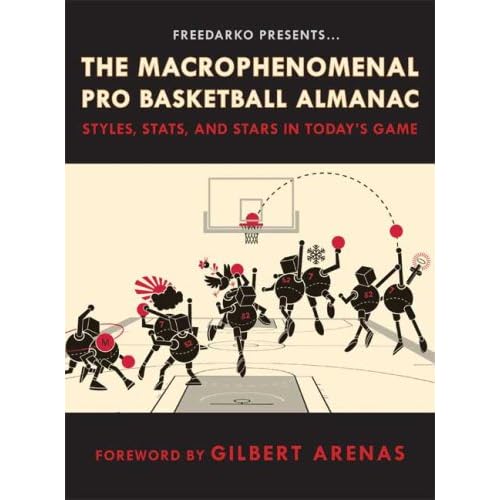
The Macrophenomenal Pro Basketball Almanac

by the FreeDarko Collective

My roommate John and I have spent a lot of time at the basketball courts of southeast Portland, shooting around, talking about sports, their ultimate meaninglessness, but our seeming attraction to them, anyway. Two scholarly, impassioned guys. Becca accompanied me to our local pizzeria to watch every game of the Trail Blazers’ first-round playoff exit against the stingy Houston Rockets; there’s a sensible lady for you--a feminist and consummate critic, scarfing down sub-par west-coast pizza, amazed at the seemingly ordinary scoring binges of Brandon Roy, learning the maddening frustration that is Greg Oden’s game and questioning what Joel Pryzbilla is emphatically saying to his teammates during a timeout.

“Why the fuck are we wasting our time with this?” we would wonder, walking home, reeking like pizza. And I know: because sports are diverting and we like even mediocre pizza. Also, basketball is an incredibly dramatic game whose personalities and styles are incredibly diverse. I literally fell out of my chair at one point when B-Roy hit a clutch three and found myself disgusted and amazed at Houston center Yao Ming’s game is so dominant but efficient.

I’ve always loved sports, but I’ve always had a hard time being smart and rationalizing my seeming obsession with sports. Enter the FreeDarko collective, a handful of NBA bloggers who are smart, well-read and willing to inflate any athlete’s personality with hyperbolic meaning and we may have the beginnings to toppling sports-writing’s ultra-bland, cliched regime.

This book focuses on a diverse array of NBA talent, from virtuosos such as Kobe Bryant, team-cancers such as Stephon Marbury and meteoric up-and-comers like Chris Paul. The book has well-researched, imaginative stats; extrapolating the time difference between how much time an average NBA player takes to score and the Phoenix Suns’ explosive PG Leandro Barbosa, we find that while it took the French 116 years to defeat the British in the 100 Years War, it would have taken Barbosa just 93.3. Tim Duncan, the most fundamental, dominating player of his era (and one so emotionless, he borders on autistic), has career stat averages that closely mirror the Fibonacci sequence. Player styles, second by second, are broken down into anatomical illustrations; Tracy McGrady’s somnambulic scoring mastery breaks down to a first move like “idle rapids,” “seemingly aimless but powerful”. As he curiously lofts the ball over a defender’s head his style is “This is Not a Pipe,” showing “the treachery of images”. As the ball careens off the backboard, T-Mac leaps up to take his own alley-oop and is imbued with the precision of a “Swiss watch”. He finishes with a dunk that conjures the “Hammer of Thor”.

The illustrations are magnificent: bright, cartoony and the players featured are lovingly caricatured. The layout is fantastic. Ron Artest, an amazing defender and the most supremely volatile star in the game, crouches, scowling as a volcano erupts in the background and bombs fall from the sky. Gilbert Arenas, always a showman, rides a unicycle on a tight rope to the hoop, while a circus scene replete with a smoking monkey riding a tiger and a lion jumping through a burning hoop surround him.

I devoured this book. These guys are obsessed with the game and have let their minds work out on story-lines and ego to a degree untouched by sports-writing. In their attempt to illustrate the complexities of their subjects, they often overreach to an absurd degree (comparing the career-path of Lamar Odom to Job “without psalms”, infusing him with Everyman’s imposed role and suffering, for example), but, man, they try. The result is a funny, devoted, well-crafted book.

I’ve often feared that professional sports are exactly what they seem, an empty vessel for corporatism, dumb masculinity and a distraction from the important things around us that so direly need our attention. And they are. This book, however, shows us that sports are full of latent drama and grace, which is why I hope to God I waste so much time watching.