Wednesday, May 6, 2009

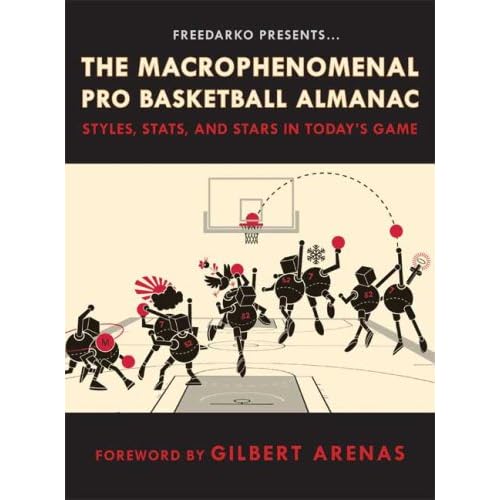
The Macrophenomenal Pro Basketball Almanac

by the FreeDarko Collective

My roommate John and I have spent a lot of time at the basketball courts of southeast Portland, shooting around, talking about sports, their ultimate meaninglessness, but our seeming attraction to them, anyway. Two scholarly, impassioned guys. Becca accompanied me to our local pizzeria to watch every game of the Trail Blazers’ first-round playoff exit against the stingy Houston Rockets; there’s a sensible lady for you--a feminist and consummate critic, scarfing down sub-par west-coast pizza, amazed at the seemingly ordinary scoring binges of Brandon Roy, learning the maddening frustration that is Greg Oden’s game and questioning what Joel Pryzbilla is emphatically saying to his teammates during a timeout.

“Why the fuck are we wasting our time with this?” we would wonder, walking home, reeking like pizza. And I know: because sports are diverting and we like even mediocre pizza. Also, basketball is an incredibly dramatic game whose personalities and styles are incredibly diverse. I literally fell out of my chair at one point when B-Roy hit a clutch three and found myself disgusted and amazed at Houston center Yao Ming’s game is so dominant but efficient.

I’ve always loved sports, but I’ve always had a hard time being smart and rationalizing my seeming obsession with sports. Enter the FreeDarko collective, a handful of NBA bloggers who are smart, well-read and willing to inflate any athlete’s personality with hyperbolic meaning and we may have the beginnings to toppling sports-writing’s ultra-bland, cliched regime.

This book focuses on a diverse array of NBA talent, from virtuosos such as Kobe Bryant, team-cancers such as Stephon Marbury and meteoric up-and-comers like Chris Paul. The book has well-researched, imaginative stats; extrapolating the time difference between how much time an average NBA player takes to score and the Phoenix Suns’ explosive PG Leandro Barbosa, we find that while it took the French 116 years to defeat the British in the 100 Years War, it would have taken Barbosa just 93.3. Tim Duncan, the most fundamental, dominating player of his era (and one so emotionless, he borders on autistic), has career stat averages that closely mirror the Fibonacci sequence. Player styles, second by second, are broken down into anatomical illustrations; Tracy McGrady’s somnambulic scoring mastery breaks down to a first move like “idle rapids,” “seemingly aimless but powerful”. As he curiously lofts the ball over a defender’s head his style is “This is Not a Pipe,” showing “the treachery of images”. As the ball careens off the backboard, T-Mac leaps up to take his own alley-oop and is imbued with the precision of a “Swiss watch”. He finishes with a dunk that conjures the “Hammer of Thor”.

The illustrations are magnificent: bright, cartoony and the players featured are lovingly caricatured. The layout is fantastic. Ron Artest, an amazing defender and the most supremely volatile star in the game, crouches, scowling as a volcano erupts in the background and bombs fall from the sky. Gilbert Arenas, always a showman, rides a unicycle on a tight rope to the hoop, while a circus scene replete with a smoking monkey riding a tiger and a lion jumping through a burning hoop surround him.

I devoured this book. These guys are obsessed with the game and have let their minds work out on story-lines and ego to a degree untouched by sports-writing. In their attempt to illustrate the complexities of their subjects, they often overreach to an absurd degree (comparing the career-path of Lamar Odom to Job “without psalms”, infusing him with Everyman’s imposed role and suffering, for example), but, man, they try. The result is a funny, devoted, well-crafted book.

I’ve often feared that professional sports are exactly what they seem, an empty vessel for corporatism, dumb masculinity and a distraction from the important things around us that so direly need our attention. And they are. This book, however, shows us that sports are full of latent drama and grace, which is why I hope to God I waste so much time watching.

Wednesday, April 8, 2009

My Brain is Hanging Upside Down

Hey all. Greetings from Woodstock library in Portland, Oregon. Wonderful to finally live the dream of a flamingly geek experience like blogging about books with ones family. Big ups, Mark and Moms.

So. Did anyone know that comics are also books? I believe some may refer to them as "graphic novels", but that's some pretentious horseshit, because they're comics. Look at them: comics. The Portland library system is awash with them. Which is good for us poor folks.

I'll be discussing are David Heatley's _My Brain is Hanging Upside Down_, his first collection.

I first happened upon Heatley's dream-journal comics in _The Best American Comics 2006_. I found them absurd, tangential, violent, sometimes racist, borne of sweaty late-night neuroses. He also published a comic detailing his complete sexual history that was in _BAC_ last year (or the year before?) _Brain_ is a collection split into five parts: sex, race, Mom, Dad, kin. He traces the arc of his family life, draws portraits of his parents in mini-comic form and presents a meandering comic about possibly every black person he's ever known. Heatley seems intent on cramming every character from his life into these comics--which, while demonstrating his honesty and drive towards authenticity, can be extremely tiresome. His section on race, which includes a few dream comics with racist imagery and scary-to-whites memes such as "the projects" and home invasion is dominated by "Black History." This essentially biograpical comic centers on Heatley's black school friends, his father's casual racism, summer camp, masculinity, his love for hip hop (replete with unnecessary record reviews), moves to several major cities (where black people are to be found), his flirtation with the struggle to free Mumia Abu-Jamal and finally (after self-referentially referring to the ponderous length of his creation), a cathartic, sobbing breakdown after a black woman hits him with her purse on the subway in New York. Heatley, enraged, goes home and curses about the "fucking nigger bitch", weeps in his wifes arms and sends a healing prayer to his assailant. No lie.

What saves these comics is Heatley's pacing when he tells stories that were confusing to him, or when things get out of hand. His inner "thoughts" as a child are marked by a distant "Peanuts"-style neuroses. His drawing style, when he crams his figures into tiny, nervous panels attains a quality somewhere between "Cathy" and New Yorker comics artist Roz Chast's ticky forms. (Burn.)

"Sex History", a collection of possibly every sexual encounter Heatley has had, is possibly the strongest piece in the book. Extemely graphic, the cartoon penises have been "carefully" blocked out by Pantheon, the book's publisher (you can still see what's going on). Naivete and confusion ensue. Hate to give everything away, but Heatley has an uneasy queer streak, which he admits to. It takes a big man to draw himself shoving a dildo in his ass.

All in all, a comic this direct gives the reader a distinct impression of the artist. Heatley, now a father and the recipient of some profound spiritual awakening (which he promises to share at a later date), is great at leading us through his tangled, claustrophobic mind. It doesn't give me the impression I'd like to hang with him for a second. The book's another brick in the wall of personal, confessional memoir comics as popularized by James Kochalka, Chris Ware and a whole host of less-talented, tedious, angsty adults. I want to say right now that comics, as popularized in anthologies, seem to be gravitating towards this trend. Heatley can be funny, maintains his seeming honesty and can be placed in the upper end of the spectrum, in terms of readability. While I certainly know that it can be cathartic to exorcise trauma through sharing, maybe it ain't always necessary to share everything with everyone. Maybe the field would narrow if some folks decided to just skip straight to Sylvia Plath-style dispair, madness and suicide instead of doing the visual/verbal equivalent of prattling on about your life to some stranger who's trapped on the bus with you. Dignity, people.