Monday, April 25, 2011

The Disappeared, by Kim Echlin

The Disappeared is yet another story about the cruelty with which humans treat one another. Set during the rule of the Khmer Rouge, the story deals with a Cambodian who escaped during the initial genocide and the Canadian wild child who fell in love with him and risked everything to be with him.

Serey is the Cambodian boy who escaped without learning the fate of his birth family. While in Montreal, he meets and has an affair with a teenager, Anne Greves, herself a motherless child with an often-absent (physically and emotionally) father. They fall in love despite the objections of Anne's father and have an idyllic affair filled with poetry and music.

What Anne fails to grasp - because it's outside her realm of perception - is that Serey can never be complete as long as he is exiled from his country and does not know the fate of his family. She understands on an intellectual level, but doesn't grasp the situation's reality until the Cambodian border opens back up and Serey immediately makes plans to go home and find his family.

Their separation ends up lasting 10 years.

In the intervening 10 years, Anne learns the Khmer language and writes letters to Serey (which he never receives; Anne never receives the letters he has written her either). She takes lovers but never falls in love. And finally, after convincing herself that she sees him on television at a rally in Cambodia, she decides to go looking for Serey. Showing enormous courage and resourcefulness, she goes to his old neighborhood - nobody has seen him. She cruises nightclubs and music halls to try to find him. She asks in the market square. Finally, she finds him.

But all is not well - this is not a book with a happy ending. They live together, resume their love affair, and Anne eventually gets pregnant. Tragically, she loses her baby when she contracts dengue fever, and then she loses Serey - he disappears again. Before he disappears, Serey finally reveals to Anne that his brother had survived the genocide...after witnessing the murder of his grandmother, mother, and father. In a last act of bravery, his father threw Serey's 10-year-old brother into the ditch on the opposite side of the road to help him escape being killed. These events, and the hardships that came after, molded Serey's brother into the perfect foot soldier for the Khmer Rouge.

Anne finally learns that Serey had been working for the resistance movement. She is warned again and again to stop looking for him. But her obsessive love will not allow her to quit and she finally finds his skull - he was killed for his resistance activities.

This book is depressing as hell; if you've ever read any books about other "disappeared" people, you'll know what I mean. The bad guys usually prevail, there is always family tragedy and loss, and the people who survive genocide are permanently damaged in ways that those of us who have not (thankfully) live through these events can probably never fully understand. It warps people - those who escaped altogether and those who escaped murder only to be conscripted into the murderers' ranks. It stunts their lives - they live with the tragedy of their murdered families and the guilt that comes with surviving such an event. Love - if they are able to have it - is deeply felt but is always accompanied by an emotional distance. This novel captures this intensity and disconnection perfectly. The plot is at turns disjointed, secretive, passionate, and tragic. This book is a tragedy.

What are YOU all reading lately??

Friday, February 25, 2011

Great Gatsby for NES!!


It's true. These folks found a pirated edition of a rare Nintendo game adapted from the Great American Novel, F. Scott Fitzgerald's The Great Gatsby. As Nick Carraway, you throw fedoras at hobos and flappers in search of Jay Gatsby.

Just like in the book.

I read this in high school. Who taught that class? Mark Sager. I can attest that when Mark teaches this, he does every character with a distinct voice, even Daisy.

Play it here.

Monday, February 14, 2011

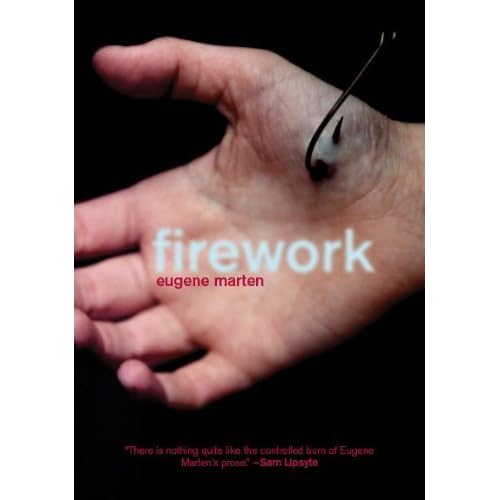
Firework, by Eugene Marten


Y'all are getting lapped.


I'm in Portland now. After two months of unseasonal warmth, the sky has decided to get gray and spit rain for this week. It definitely beats the Snowpocalypse in the northeast, though.


Well, to mark my glorious return, we're gonna look at a book that unwittingly took me back here a week before I actually arrived and shattered my expectation for a protagonist. Firework, by Eugene Marten.


First off, I want to say that one person this book is dedicated to is Gordon Lish. I don't know the connection between Marten and Lish (there's very little about Marten out there), but this book is reminiscent of the hard, existential daily-life realism that Raymond Carver worked in, as well as the supreme stylistic flourishes of that realism that can be found in Amy Hempel and Tom Spanbauer. Like Palahniuk (a student of Spanbauer), Marten loves to write in the language of physical process and parts, which contrasts his main character rather well, because, compared to all the knowledge and names surrounding him, he's just a regular guy writing a crappy screenplay and is dissatisfied about his life, but not imaginative enough to change anything. He only knows that he used to be brave.


Marten stretches and spins ordinary minutae to plumb the depths of an incapable, nearly-opaque, and not-entirely-likable character, Jelonnek, who reminded me of Denis Johnson's character, Fuckhead, from Jesus' Son, in that he is ignorant, afraid and utterly awash in a world of confusing relationships and interactions, in which he is some dangerous, reactive element.


This book is unique in that it's only calm spots are a disintegrating stasis. Jelonnek is a state worker who oversees a forms warehouse in what is most likely Cleveland and watches the same football game on a tape over and over again while the indecipherable events of the world go on around him. In a quest for the only greatness he's capable of, Jelonnek gets into some crazy one-man-apocalypse shit.


This is a book about race. The LA riots are a constant fixture on television in the narrative. Also, Jelonnek is attracted to black women and, after a terrifying incident utterly disrupts his life, he takes a black prostitute named Littlebit and her daughter Miss D across the country, to Portland in a not-at-all thought-out act of altruism we as readers know he is incapable of. The situation itself seems impossible for anyone.


There are moments punctuated by humor. Like I said, Jelonnek is sympathetic if not likable. When he does some embarrassing shit or suffers some sort of confusion, or utter calamity, you feel for him and can laugh at him. He's utterly human, in the way that little about him is admirable and that he is seemingly consigned to perpetual failure.


What happens when our characters reach their destination is more spiraling down, then an impermanent salvation, followed by some hellish descent. The narrative gets entirely fatalistic and hallucinatory towards the end, leading to something that's been looming, but is shocking nonetheless. Whoever wrote the synopsis on the back cover projects some sort of hope into the outcome. I guess it's a hope that's consistent with the text, but holy shit, what a mixed bag. Jelonnek does get to be the hero, but he's the monster, too.


I have never read anything quite like this. I don't know as it's a fair book to black people, but I believe it's written from the perspective of someone who could never figure anyone out in the first place. If any of y'all read it, I'd be happy to talk about it with y'all.


Highly recommended. Re-reading Johnson's Angels next, 'cause Bill Houston came to mind. Same deal. And we know how he turned out.


An excerpt from the novel can be found here. Good reading, folks.

Monday, January 31, 2011

The Blind Assassin


by Margaret Atwood


I'm in western New York right now. There's snow all over everything and more coming. I need more books like this, or I'll peck all the feathers from my cage-mates. I'm currently into Eugene Marten's Firework and I have two huge volumes of Lynd Ward's woodcut novels. Also The Power of Myth; Joseph Campbell with Bill Moyers.


Right now, let's stick with The Blind Assassin. Mom, I could just walk downstairs and tell you about this book, but you're ab-blasting. Mark, you ever read this?


Iris Chase Griffen is our narrator, a kept woman, born into a well-to-do industrial family, the daughter of a button magnate. Her sister, Laura, is a well-respected author, whose sole book The Blind Assassin is published shortly after her mysterious death, a hushed-up suicide.


Atwood's intertwined narrative, Laura's novella, The Blind Assassin, is about a nameless high-society woman and her lover, a Communist pulp sci-fi writer who moves from borrowed room to borrowed room, evading the Red Squads. It's a One Thousand Nights and a Night analogue, a high-spun sanctuary for the two.


See where this is going? Sci-fi as philosophy, trysts, stifled femininity, the Spanish Civil War... metanarrative...


The Chase sisters, born after World War I, are imbued with a fairy-tale quality. Two little girls sheltered on their family's estate, raised by a house-servant, while history ruptures around them in the fictionalized town of Port Ticonderoga, Ontario. Iris is practical, but intrigued by the artifacts of her dead grandmother, a cultured socialite. Laura is both pious and childishly literal in a way that makes understanding God both concrete and hopelessly confusing. Laura becomes highly problematic for those around her; dreamy and mystified by what she sees, living in an age when puzzling women were brutally solved. At a Chase company picnic, they make the acquaintance with a young radical named Alex Thomas. This will have consequences. When tragedy hits their family and fortune, they are cast into the grasp of Richard Chase, an ambitious textile baron and rival of their father, and his viperish sister Winifred. Both are in severe danger of what is understood as growing up will spring on them.


Iris, telling her story from her old age, is mercilessly sarcastic about her decaying body, the disgraces of aging. Mix that with her spot-on recollection of her childhood, her marriage, the fashions, the customs, the hard-to-navigate codes of conduct that women were meant to abide by and her formation within them. Her guilt over her inattention to, and complicity in, what she's trying to reveal. Iris grapples with what she is leaving obscure, but within the progression of the narrative, things cannot be hidden, only delayed.


As for what I like? There's all the obvious historical stuff, the strikes, the threat of sinister “anarchists,” the enormously divergent highs and lows of the epoch in which two World Wars are fought. I love first-person. I love the interspersed newspaper accounts bluntly announcing deaths, marriage, glamorous parties, disappearances. I love the novel-within-the-novel and Atwood's confidence in not only bringing these texts and voices together, but composing them as a powerful, but tender narrative.


Atwood's as sharp, funny, imaginative and commanding as ever. This is a heavily researched, careful book, but she synthesizes it into a rhythm that carries it. At home writing macho dialogue for two American jet pilots fighting the lizard men of Xenor as she is a tumultuous, impossible love affair, Atwood builds us several dimensions of experience in which to see things, takes command of her worlds, obliterates them and offers you hope that they could be rebuilt.


Hells yes, this book.