Y'all are getting lapped.
I'm in Portland now. After two months of unseasonal warmth, the sky has decided to get gray and spit rain for this week. It definitely beats the Snowpocalypse in the northeast, though.
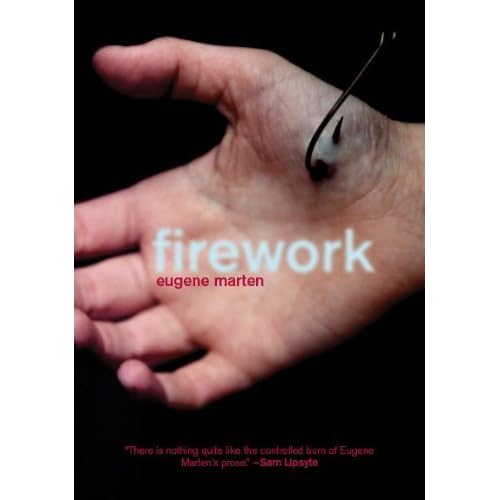
Well, to mark my glorious return, we're gonna look at a book that unwittingly took me back here a week before I actually arrived and shattered my expectation for a protagonist. Firework, by Eugene Marten.
First off, I want to say that one person this book is dedicated to is Gordon Lish. I don't know the connection between Marten and Lish (there's very little about Marten out there), but this book is reminiscent of the hard, existential daily-life realism that Raymond Carver worked in, as well as the supreme stylistic flourishes of that realism that can be found in Amy Hempel and Tom Spanbauer. Like Palahniuk (a student of Spanbauer), Marten loves to write in the language of physical process and parts, which contrasts his main character rather well, because, compared to all the knowledge and names surrounding him, he's just a regular guy writing a crappy screenplay and is dissatisfied about his life, but not imaginative enough to change anything. He only knows that he used to be brave.
Marten stretches and spins ordinary minutae to plumb the depths of an incapable, nearly-opaque, and not-entirely-likable character, Jelonnek, who reminded me of Denis Johnson's character, Fuckhead, from Jesus' Son, in that he is ignorant, afraid and utterly awash in a world of confusing relationships and interactions, in which he is some dangerous, reactive element.
This book is unique in that it's only calm spots are a disintegrating stasis. Jelonnek is a state worker who oversees a forms warehouse in what is most likely Cleveland and watches the same football game on a tape over and over again while the indecipherable events of the world go on around him. In a quest for the only greatness he's capable of, Jelonnek gets into some crazy one-man-apocalypse shit.
This is a book about race. The LA riots are a constant fixture on television in the narrative. Also, Jelonnek is attracted to black women and, after a terrifying incident utterly disrupts his life, he takes a black prostitute named Littlebit and her daughter Miss D across the country, to Portland in a not-at-all thought-out act of altruism we as readers know he is incapable of. The situation itself seems impossible for anyone.
There are moments punctuated by humor. Like I said, Jelonnek is sympathetic if not likable. When he does some embarrassing shit or suffers some sort of confusion, or utter calamity, you feel for him and can laugh at him. He's utterly human, in the way that little about him is admirable and that he is seemingly consigned to perpetual failure.
What happens when our characters reach their destination is more spiraling down, then an impermanent salvation, followed by some hellish descent. The narrative gets entirely fatalistic and hallucinatory towards the end, leading to something that's been looming, but is shocking nonetheless. Whoever wrote the synopsis on the back cover projects some sort of hope into the outcome. I guess it's a hope that's consistent with the text, but holy shit, what a mixed bag. Jelonnek does get to be the hero, but he's the monster, too.
I have never read anything quite like this. I don't know as it's a fair book to black people, but I believe it's written from the perspective of someone who could never figure anyone out in the first place. If any of y'all read it, I'd be happy to talk about it with y'all.
Highly recommended. Re-reading Johnson's Angels next, 'cause Bill Houston came to mind. Same deal. And we know how he turned out.
An excerpt from the novel can be found here. Good reading, folks.